Research
Soil science, measured
on working farms.
We study what is happening beneath Ghanaian farms — moisture, acidity, nutrients and contaminants — and turn what we learn into advice farmers can act on, in the languages they speak.
What we study
What we measure, and why.
Each line of work starts with a reading on a real plot and ends with something a farmer can do this season.
Soil health monitoring
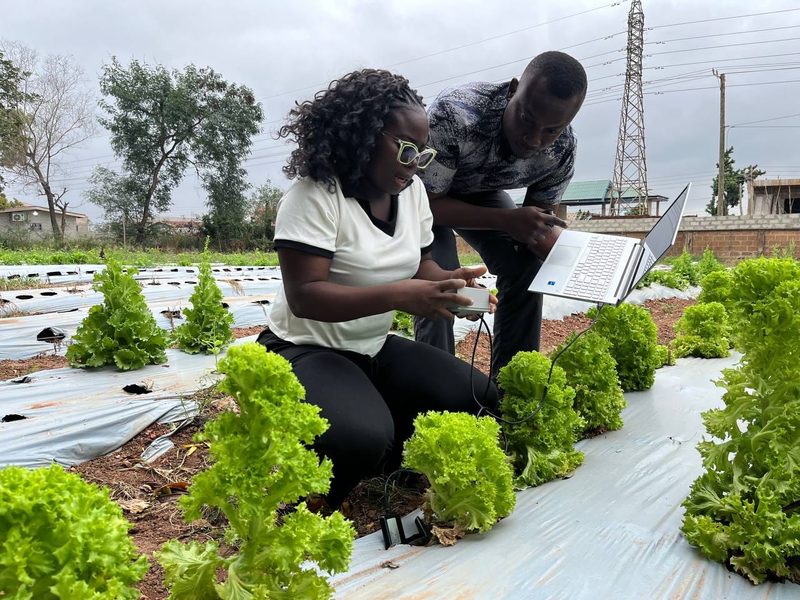
In-field SoilPulse Probe sensors log moisture, pH, EC, temperature and NPK sector by sector, so change is read across a season rather than judged from a single day.
Contamination screening
Early warning for heavy metals in soil that grows food, benchmarked against WHO and FAO safe-consumption thresholds so risk is flagged before harvest, not after.
Regenerative practice
Tracking carbon sequestration, cover crop coverage and water conservation over seasons, alongside field guidance on phytoremediation, composting and agroforestry.
Advice people can use
Studying how agronomic advice lands when it is given in English, Twi, Ewe, Ga and Hausa, whether as text, a voice note or a call with a field agent.
How we work
From a reading to a decision.
The same three steps on every plot, whether it grows lettuce outside the city or cocoa under shade.
- 01
Measure on the plot
Sensors go into the farmer’s own beds, sector by sector, and readings are taken with the farmer, not for them.
- 02
Check against known ranges
Readings are compared with agronomic ranges for the crop and, for heavy metals, with WHO and FAO thresholds.
- 03
Return it as advice
Results go back to the farmer as plain recommendations in their own language, with a field agent a message away.
Research data
Research runs on consent.
Farm data belongs to the farmer. Research sharing is a separate permission, and nothing that identifies a farmer leaves SoilPulse without their say. The full details are in our Privacy Policy.
- Off until you switch it onResearch sharing is its own permission. Your advice and records work the same either way.
- Grouped and anonymisedPartners see figures such as the average soil pH in a district, never a single farm.
- Nothing that identifies youNo names, contact details, photos or exact farm coordinates go to a research partner.
- Change your mind at any timeWithdraw the permission whenever you like, at no cost.
Where we are
Early, and open about it.
SoilPulse AI is at the prototype stage. These are today’s numbers; findings will be published here as the work matures.
- 2Sensor prototypes
- 1Farm
- 2Regions
- 5Languages for advice
Research with us
Study soil with us.
Universities, agronomists and extension services working on soil in West Africa: we would like to hear from you.